Contact us
Send Us Your Case Details
We’ll respond and let you know the best way to proceed with your case.



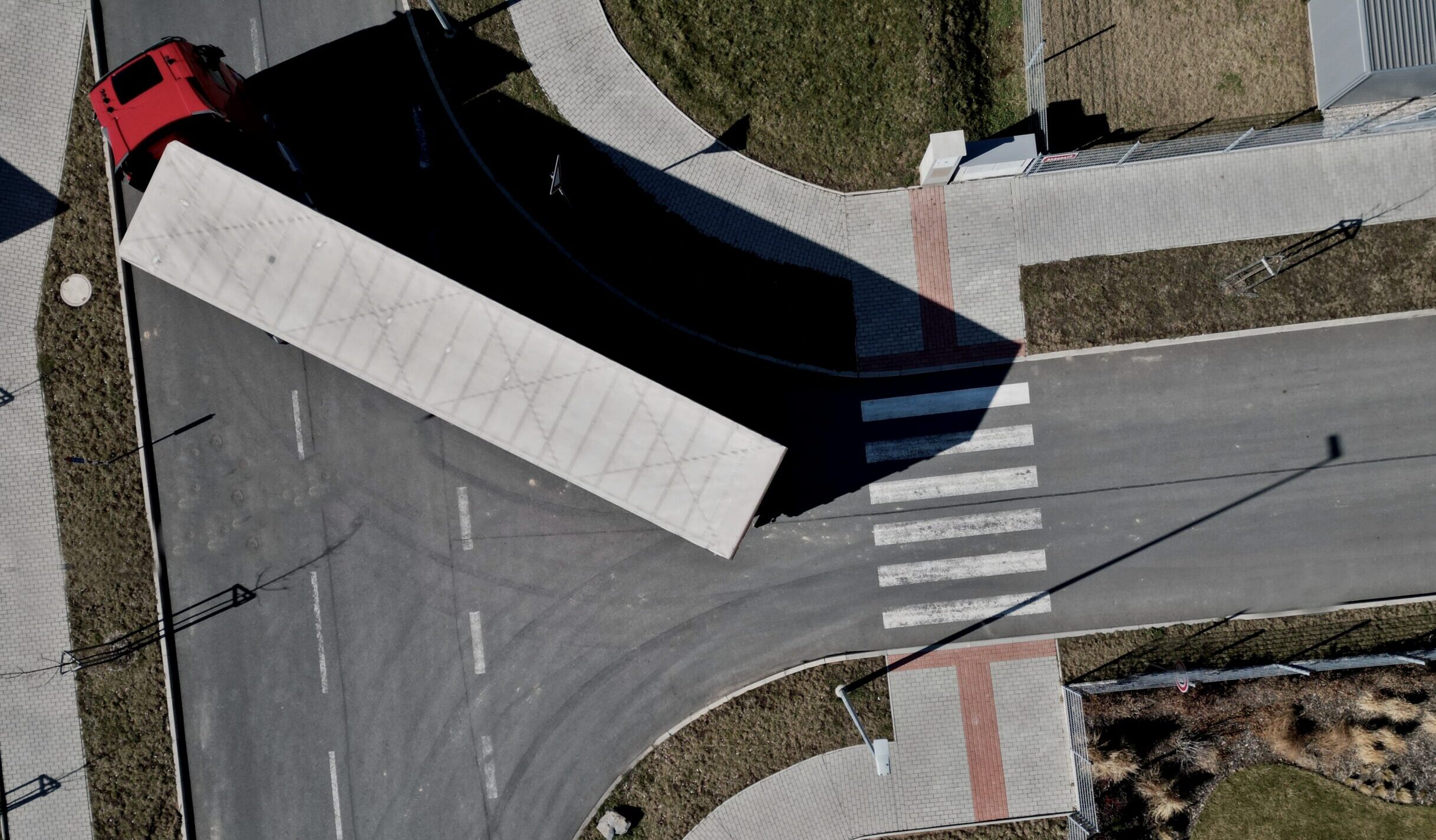
Off-tracking is the difference between the path followed by a truck’s steering wheels and the path followed by its rear trailer wheels during a turn. During slow, tight turns, the trailer’s rear wheels typically follow a tighter path inside the tractor’s path, often called “cutting the corner.” This is why you may see 18-wheelers move wide before completing what appears to be an ordinary turn. When a truck driver misjudges the space needed for a turn, fails to monitor nearby traffic, or turns without ensuring the path is clear, the tractor or trailer can strike vehicles, cyclists, or pedestrians near the intersection.
The Osiris A. Gonzalez Law Firm represents injured victims of truck accidents throughout South Texas. Call us today at 956-855-5555 if you have been involved in a collision with a commercial truck.
Off-tracking happens because a truck’s trailer does not follow the exact same path as its cab through a turn. The rear wheels of the trailer track a shorter, tighter arc than the front wheels of the tractor, meaning the back of the trailer effectively cuts the corner compared to where the front of the truck is heading.
For example, when a tractor-trailer makes a right turn, the driver may first guide the cab farther into the intersection or, where lawful and safe, use additional space to position the trailer for the turn. That maneuver helps keep the trailer’s rear wheels from mounting a curb or striking objects near the corner.
Drivers, cyclists, and pedestrians near the truck’s right side may not expect this movement, which is why careful observation and signaling are critical.
The amount of off-tracking a truck experiences during a turn depends on several factors, including the length of the trailer, the wheelbase of the tractor, the specific angle of the turn, and the truck’s speed.
Longer trailers and tighter turns generally produce more pronounced off-tracking, since there is more distance between the front and rear axles for the geometry to play out over.
Off-tracking behaves differently depending on speed. At low speeds, such as navigating a tight turn at an intersection, the trailer’s wheels track sharply to the inside of the turn, sometimes called “low-speed off-tracking.”
At higher speeds, such as on highway curves or ramps, high-speed off-tracking may occur. In those circumstances, the rear of the truck or trailer can move outward relative to the tractor’s path, with the amount of movement affected by speed, turn radius, axle spacing, loading, tires, and suspension characteristics.
Both conditions require a commercial driver to understand the vehicle’s handling characteristics and operate at a speed and position appropriate for the roadway and surrounding traffic.
There is no universal turning-radius or clearance measurement for every semi-truck. The space required depends on the tractor and trailer configuration, wheelbase, trailer length, axle placement, turn angle, roadway width, curb design, and surrounding obstacles. Drivers must evaluate the available space before committing to a turn and make the maneuver only when it can be completed safely.
Understanding wide turns and the way large commercial vehicles track through turns is an important part of commercial-driver knowledge and skills training. Texas CDL materials instruct drivers of large vehicles to turn wide when necessary, and federal CDL standards include knowledge of basic commercial-vehicle control.
Because off-tracking varies based on the vehicle and situation, proper training is essential to teaching drivers how to judge turns safely, position their vehicle appropriately before initiating a turn, and account for other road users who may not anticipate how far a trailer’s rear wheels will swing. A driver who has not been adequately trained, or who becomes complacent about this fundamental skill, is far more likely to misjudge a turn and cause a collision.
Off-tracking accidents typically occur when a truck driver fails to properly account for how the trailer will move through a turn, whether by failing to swing wide enough beforehand, misjudging the space needed, or simply not checking for other vehicles, cyclists, or pedestrians positioned in the truck’s path during the maneuver.
Common scenarios include:
Liability for an off-tracking accident depends on the specific facts of the crash, since the mere fact that a truck needed extra room to turn does not by itself establish negligence. What matters is whether the driver and any other responsible parties exercised reasonable care given the truck’s known turning characteristics.
A truck driver may be liable if they failed to properly position their vehicle before a turn, failed to check for other vehicles or pedestrians in their path, or otherwise failed to exercise the level of care a properly trained driver would have applied to the same turn.
The trucking company, often called the motor carrier, may share liability if inadequate training, poor hiring practices, or a failure to properly maintain the vehicle contributed to the crash. In some cases, a trucking company’s own policies or scheduling pressures may have contributed to a driver rushing through a turn that should have been taken more carefully.
Depending on the circumstances, other parties may also share responsibility, including a government entity, if poor intersection design failed to account for the reality of commercial truck traffic in the area, or a company responsible for loading the trailer, if an improperly loaded or overweight trailer affected the truck’s handling during the turn.
Potential evidence may include camera footage, scene photographs, witness accounts, police reports, driver qualification and training records, vehicle inspection and maintenance records, telematics or electronic data when available, and accident-reconstruction analysis.
If a commercial truck’s wide turn injured you or someone close to you, The Osiris A. Gonzalez Law Firm can review the available evidence and explain your options. Call 956-855-5555 to discuss a potential truck accident claim with a South Texas legal team.
If you have been injured in a collision with a truck making a wide turn, taking the right steps can help protect both your health and your legal rights:
Off-tracking accidents throughout McAllen, Harlingen, Brownsville, the Rio Grande Valley, San Antonio, and Houston often require a careful analysis of both the truck’s specific geometry and the driver’s conduct leading up to the collision. Our truck accident attorneys investigate driver training records, company policies, and available electronic data to determine whether a wide turn reflected reasonable, necessary caution or a preventable failure to account for the trailer’s path.
We also handle broader commercial vehicle accident and car accident claims throughout South Texas.
If you or a loved one has been injured in a collision involving a truck’s wide turn, contact The Osiris A. Gonzalez Law Firm at 956-855-5555 for a free consultation.
Off-tracking describes the difference between the path followed by a truck’s steering wheels and the path followed by its rear trailer wheels during a turn. In a slow, tight turn, the trailer’s rear wheels usually follow a tighter path inside the tractor’s path, which can cause the trailer to cut toward the curb or corner. Because of this, large trucks often need additional room to complete turns safely.
An 18-wheeler may need to move wide before a turn so the trailer has enough clearance to pass through the intersection without its rear wheels cutting too sharply toward the curb. The exact amount of space depends on the vehicle’s configuration, the turn angle, the roadway design, and nearby obstacles. A wide turn does not automatically mean the driver acted improperly, but the driver must still make the maneuver carefully and account for nearby road users.
Yes. Off-tracking is a normal characteristic of tractor-trailers, but it does not excuse unsafe driving. A driver may be held responsible when the evidence shows the driver failed to use reasonable care, such as by making an unsafe turn, failing to check mirrors and blind spots, ignoring nearby traffic, or attempting a turn without adequate clearance.
In some cases, the trucking company or motor carrier may share responsibility for a wide-turn crash. Relevant issues can include driver hiring, training, supervision, maintenance, dispatch practices, and compliance with applicable safety requirements. Whether the company is liable depends on the evidence, the parties’ legal relationship, and the facts of the specific collision.
Seek medical care as soon as possible and call law enforcement so that an official crash report can be prepared. If you can do so safely, photograph the vehicles, roadway layout, tire marks, traffic controls, and visible injuries, and collect contact information from witnesses. Before giving a recorded statement or accepting a settlement offer, consider speaking with The Osiris A. Gonzalez Law Firm at 956-855-5555 about preserving evidence and understanding your options.